

March 3, 2026
What FirstService’s Q4 Earnings Reveal for Community Association Management Company Owners

.jpg)
What FirstService’s Q4 Earnings Reveal for Community Association Management Company Owners
During its most recent earnings call, FirstService Corporation made several observations about acquisitions that owners of community association management companies may find revealing.
For owners of privately held community association management companies, these signals provide useful context. Public disclosures from best-in-class companies like FirstService offer a rare window into how sophisticated investors evaluate the industry, how large platforms approach acquisitions, and how management teams frame the long-term opportunity.
The company’s recent Q4 earnings call and February 2026 investor presentation reinforce several themes that are directly relevant to independent owners considering growth strategies or evaluating the timing of a potential sale.
Expansion Beyond Core Management Services
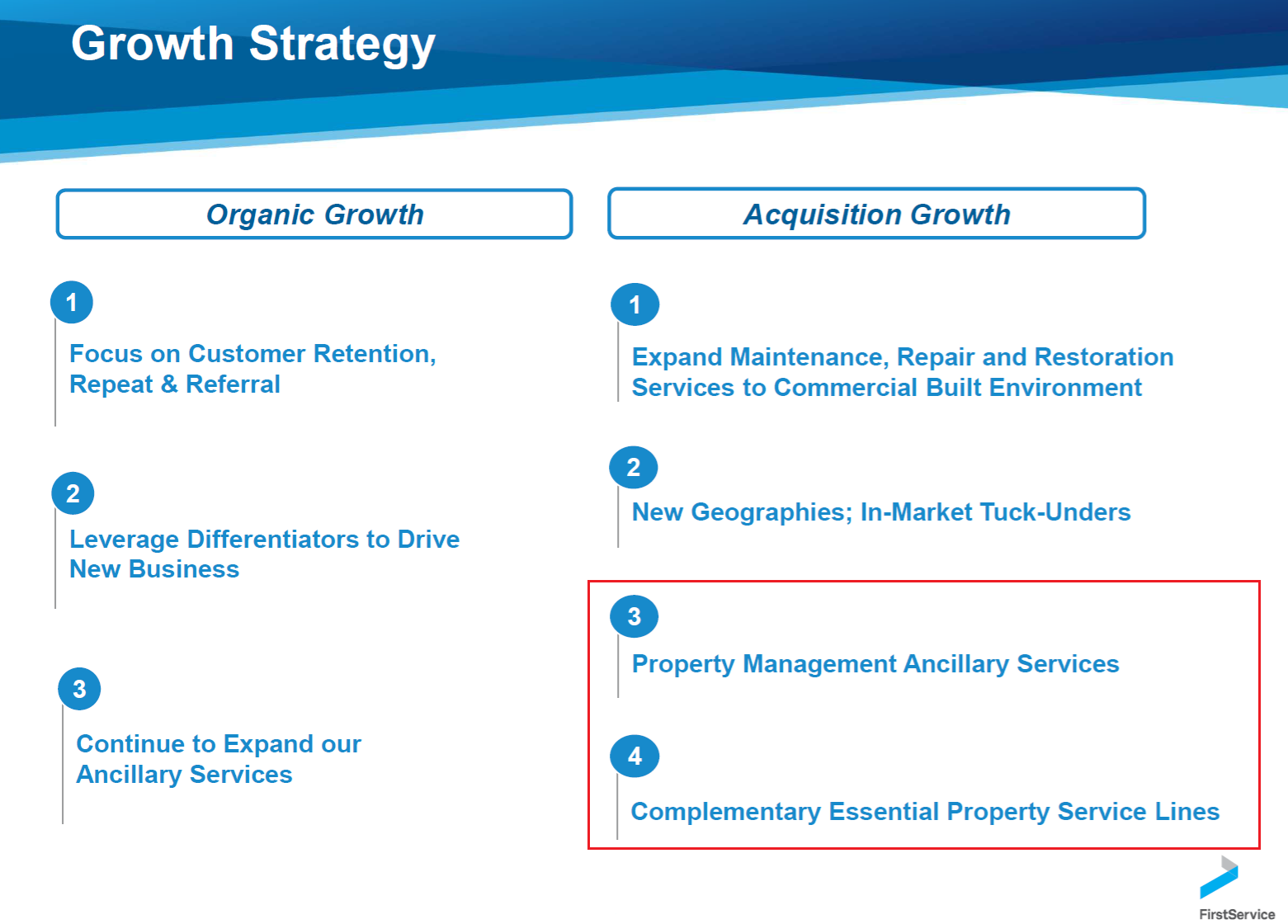
One theme highlighted in the investor presentation is the combination of organic growth and acquisitions as complementary drivers of expansion across both FirstService Residential and the company’s broader service platform.
Organic growth can come from new client relationships, expanded services within existing markets, and operational improvements across the organization. Acquisition growth occurs through tuck-in transactions and the addition of complementary service capabilities.
Over time, large platforms often expand beyond their core services into adjacent offerings that support the communities they serve. This allows operators to deepen relationships with existing clients and diversify revenue streams across multiple service lines.
While FirstService does not disclose a specific penetration rate across its service offerings, the company’s strategy suggests these complementary services represent a meaningful long-term opportunity.
For independent owners, this reinforces an important point. Buyers evaluating community association management companies are often thinking about the broader ecosystem of services surrounding managed communities, not just the management function itself.
EBITDA Remains the Central Performance Metric
The earnings call also provides insight into how sophisticated investors evaluate performance. In discussing forward expectations, management noted:
"In terms of consolidated EBITDA for the first quarter, we expect to be roughly in line with Q1 2025. For the balance of the year, we anticipate EBITDA year-over-year growth in the high single digits at similar rates or slightly better than revenue growth."
For private company owners, this reinforces the role EBITDA plays as the central metric for evaluating financial performance in transaction markets. While revenue growth and operational metrics remain important, buyers ultimately evaluate businesses based on the durability and growth of EBITDA.
Potential Supply From Private Equity Remains a Key Question
The earnings call also included discussion around the acquisition market and the level of competition for deals. It's important to note the M&A commentary is not specific to only management, but also the other pieces of FirstService's business.
During the Q&A session, an analyst asked:
"... Cracks appear to be showing in private equity; various reports suggesting that mid-market firms are holding on to investments they can't sell and then struggling to raise capital to buy businesses. Is that, you know, that in theory should be positive for strategic buyers like FirstService? From your perspective, are you seeing any change? Is the competitive landscape improving from where it was three, six, or twelve months ago?"
Management responded:
"We haven't seen it yet ... It's definitely a slower market than, say, twelve months ago. ... We know of a number of opportunities that have been pulled or delayed until the environment improves. And there's no indication that multiples are trending higher or lower. They still remain high across the board. We haven't seen mid-market private equity deals come to the market. Really, we haven't seen it yet."
What is notable about this exchange is not only what management said, but what it did not say.
The analyst’s question presupposed a common view among market participants: that private equity fund life constraints could eventually force more portfolio companies to come to market, increasing supply and putting pressure on acquisition multiples. FirstService did not dispute that possibility. Instead, management indicated that it has not yet seen that dynamic play out in the transactions currently reaching the market.
For owners of community association management companies, this distinction matters. Expectations about future supply of businesses can influence buyer behavior and valuation dynamics even before those transactions occur. If a larger number of private equity-owned service businesses eventually come to market, competition among sellers could increase and acquisition multiples could adjust.
For now, however, FirstService’s commentary suggests that the anticipated increase in supply has not yet materialized in a meaningful way. Valuations for quality service businesses continue to remain elevated.
Strategic Buyers Continue to Compete With Private Equity
Another exchange on the call focused on how the company approaches acquisitions when valuations remain high.
"My first question, going back to M and A for a minute, appreciate the comments on the competitiveness in that market. Can you talk about if valuations remain high, whether it's through 2026 into 2027, does that change your approach at all? Do you change the risk profile of the businesses you buy, or do you pay higher valuations? How do you approach it as multiples and the competition for M and A remains elevated?"
Management responded:
"We would approach it the same way we did this past year. As Jeremy said, we allocated over $100 million on tuck-unders. These are solid add-ons with great leadership that fill white space for us or add to our service line. In most cases, we were able to differentiate ourselves from private equity. Increasingly, we're seeing opportunities to do that with families and owners that want to be in a family where they're not resold. They want a forever owner."
The notable point in this exchange is that FirstService’s management team explicitly views this distinction as a competitive advantage in acquisition processes.
In other words, the company believes that positioning itself as a long-term owner, rather than a buyer operating within a defined fund life, helps it win transactions even when competing against well-capitalized private equity buyers.
This dynamic reflects how buyer narratives often influence seller decisions during competitive processes. While valuation remains central, buyers also position themselves around permanence, operating philosophy, and the long-term future of the business.
It also raises an interesting question. Private equity firms are often characterized as short-term owners because they ultimately exit investments within a defined fund life. Public companies, however, report earnings quarterly and operate under constant scrutiny from public markets. In some respects, those quarterly performance expectations can create pressures that are at least as short-term focused as the investment timelines typically associated with private equity.
For owners evaluating potential buyers, the distinction between capital structures is still meaningful. But as FirstService’s commentary illustrates, the way buyers frame those distinctions can be just as important as the distinctions themselves.
What These Signals Suggest for CAM Owners
Taken together, the investor presentation and earnings call offer several insights into how large buyers currently view the sector.
Large operators continue to think beyond core management contracts and consider the broader ecosystem of services surrounding managed communities. Ancillary service capabilities can deepen client relationships and create additional revenue streams within an existing portfolio of associations.
At the same time, management commentary reinforces that EBITDA remains the primary metric through which sophisticated investors evaluate operating performance. For owners considering long-term strategic positioning or a potential transaction, the durability and growth trajectory of EBITDA continue to shape how buyers assess value.
The discussion around acquisitions also illustrates how buyers position themselves in competitive processes. Strategic operators increasingly emphasize permanence and long-term ownership as part of their differentiation when competing with private equity buyers.
Finally, the exchange regarding private equity fund life constraints highlights a dynamic that many market participants are watching closely. If a larger number of private equity-backed service businesses eventually come to market as funds reach the end of their investment cycles, the resulting increase in supply could influence valuation dynamics across the sector.
For owners of community association management companies, understanding how large buyers describe the industry can provide useful perspective when evaluating growth strategies, acquisition opportunities, or the timing of a potential sale.
Subscribe to our newsletter!
Get the latest industry insights and market updates from CAM Advisors.