

February 2, 2026
What Buyers Care About in HOA Management Companies: 2026 Update


We continue to see owners anchor on valuation outcomes without clear visibility into how buyers actually define quality, durability, and risk.
When we first published our framework on what drives buyer interest in community association management businesses, the goal was simple: help owners understand how buyers actually underwrite businesses, rather than focusing solely on headline multiples or anecdotes from isolated transactions.
That core goal has not changed.
What has changed since 2025 is how clearly certain operational factors now separate average businesses from stronger ones in the eyes of buyers. In particular, labor structure and technology-enabled workflows have moved from “nice to have” considerations to central components of how buyers assess resilience, scalability, and long-term margin durability.
This updated framework reflects what we are seeing in 2026. It is intentionally a working document. Buyer expectations evolve, operating models change, and we believe owners are best served by understanding how those shifts are happening in real time. We will continue to update and share this framework as the market evolves.
How to Use This Framework
Before diving in, two clarifications are important.
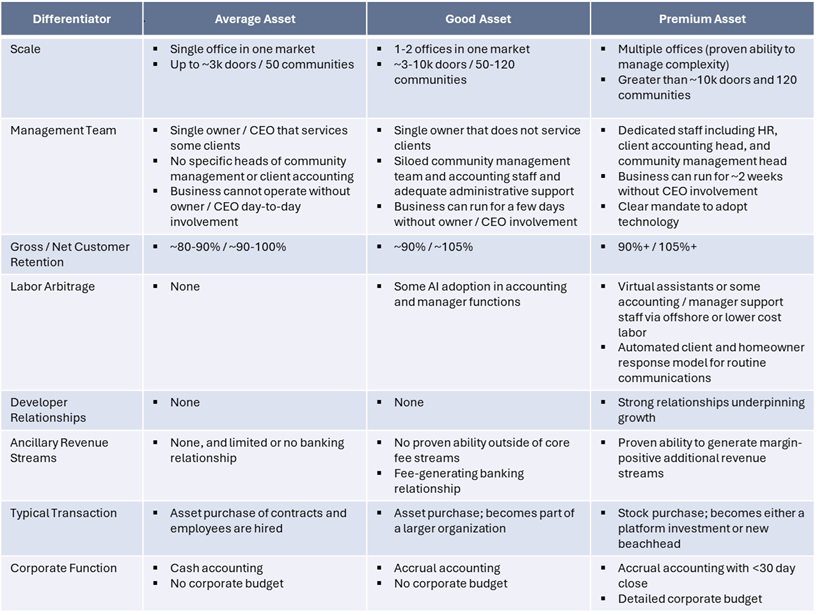
First, this is not a checklist. Very few businesses fit cleanly into a single category. Most span columns, for example strong in customer retention, developing in management depth, and less mature in corporate infrastructure.
Second, moving from “average” to “premium” is not about chasing a multiple. It is about reducing buyer risk, increasing durability, and expanding the universe of buyers who can credibly underwrite the business.
With that context, below is a snapshot of how buyers are distinguishing between average, good, and premium assets in 2026.
What Changed Since 2025: Labor and Technology Are Now Central
Many elements of this framework, including scale, retention, management depth, and transaction structure, have been consistent for years. The most meaningful evolution since 2025 sits squarely in labor strategy and technology adoption.
Labor Is No Longer Just a Cost Line
In 2026, buyers are far less focused on how inexpensive labor is and far more focused on how intentionally it is deployed.
Stronger assets increasingly reflect labor models where routine, repeatable tasks are handled through virtual assistants or lower-cost support staff, while senior team members focus on higher-value, relationship-driven work. Buyers also look for labor structures that can scale without requiring proportional increases in headcount as the business grows.
This is not about labor arbitrage for its own sake. Buyers are underwriting whether labor structure reduces key-person risk, improves consistency of service delivery, and lowers the risk of burnout for key employees and functions.
Businesses that have not addressed this often feel brittle under buyer scrutiny, even when revenue and EBITDA appear healthy on paper.
Technology and AI Adoption Have Become Table Stakes
In 2025, experimentation with AI and workflow automation was uneven across the industry. In 2026, technology-enabled operating models are assumed in any well-run business.
At a minimum, buyers expect to see best-in-class software underpinning accounting, reporting, and manager workflows, along with early use of AI-enabled tools to reduce manual work and rework.
At the strongest end of the spectrum, technology adoption extends further. Buyers increasingly value automated response models for routine communications, organization-wide adoption of technology rather than optional usage, and systems that allow senior staff to focus on judgment-driven work instead of inbox management.
What matters to buyers is not the specific tools used, but whether the technology stack meaningfully changes how the business operates.
Why This Framework Will Continue to Evolve
We are explicit with owners that this framework is not static. Buyer expectations change as labor markets shift, technology becomes more accessible, private equity platforms mature, and operating best practices spread across the industry.
Publishing this framework on a recurring basis is intentional. The goal is not to declare a final answer, but to help owners understand where buyer expectations are moving early enough to respond thoughtfully rather than reactively.
A Final Thought for Owners
Strong outcomes are rarely the result of a single initiative. They are typically the product of many small, intentional decisions made over time, often well before a transaction is contemplated.
This framework is meant to help owners orient those decisions. Not to pressure anyone into selling, but to ensure that when buyers do engage, the business is durable, understandable, and positioned to be taken seriously.
We will continue refining this framework and sharing what we see as the market evolves.
Subscribe to our newsletter!
Get the latest industry insights and market updates from CAM Advisors.